

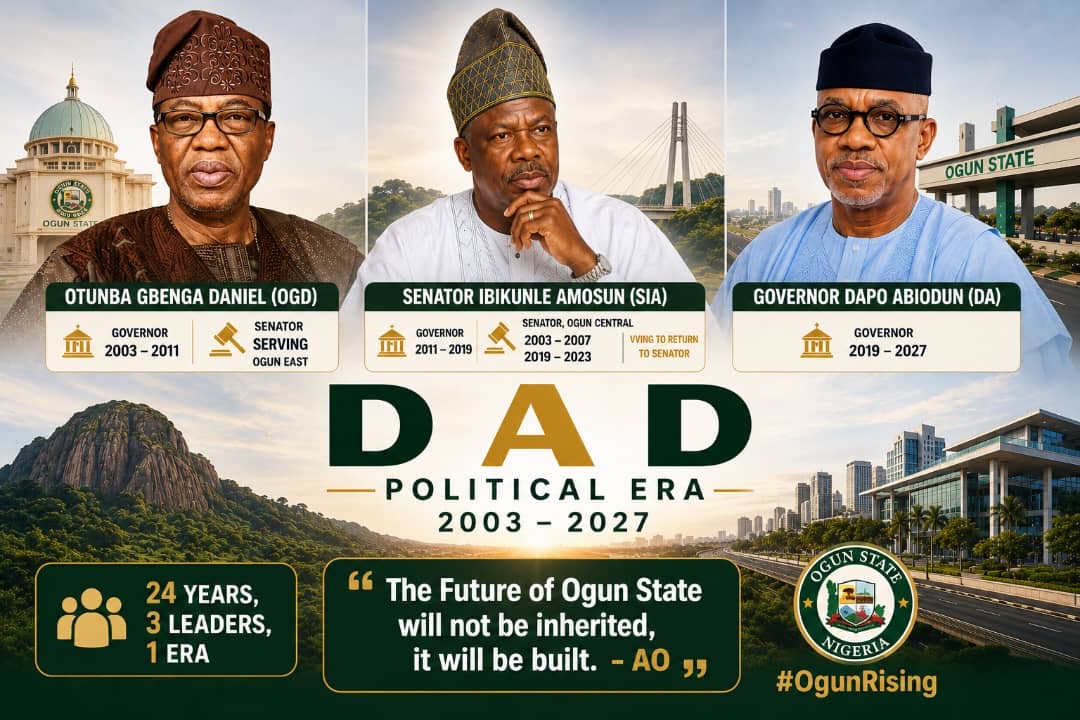
Perhaps one of the most important political conversations Ogun State must honestly have ahead of 2027 is not merely about succession, but about the deeper meaning of leadership, transition, institution-building and the future of governance in our state.
Since 2003, Ogun State has largely been shaped by three dominant political actors and friends at different points in time — Otunba Gbenga Daniel, Serving senator(D), Senator Ibikunle Amosun (A), and the incumbent Governor Dapo Abiodun (D); a sequence I simply describe as the “DAD” political era — not merely from the coincidence of initials, but because the trio have, in many ways, become the defining fathers of modern Ogun politics. By 2027, they would collectively account for 24 uninterrupted years of governance within the same broad political ecosystem.
Without attempting to rate or compare their individual performances, one truth remains difficult to ignore: despite the resources, political capital, influence, federal access, human assets and enormous sacrifices invested over the years, Ogun State still remains significantly behind its true developmental potential.
That reality alone should force a deeper reflection.
Even more interesting is the pattern that has defined the political relationship among the three leaders over the years. While one governs, complete alignment has almost never existed. At different moments, two are usually politically aligned against one. Alliances shift. Tensions evolve. Rivalries emerge. Political camps reorganize. The cycle repeats.
Today, Otunba Gbenga Daniel, a former Governor (2003-2011)serves as the Senator representing Ogun East, while Senator Ibikunle Amosun former had previously represented Ogun Central(2003-2007, 2019-2023) in the Senate after his tenure as Governor(2011-2019) and remains one of the most influential political actors in the state. The incumbent governor, Dapo Abiodun(2019-till date), is also in a political tussle with his former friend and former Governor OGD to replace him at the Senate after the completion of his tenure to represent Ogun East Senatorial District. In many ways, this reflects the continuing dominance and influence of the same political generation over the state’s power structure.
And while politics naturally accommodates competition, the cumulative effect of prolonged elite conflict on governance, state focus, resource deployment and institutional continuity cannot be ignored.
This long political era has consumed enormous state energy. It has cost individuals relationships, resources, opportunities, emotional investments and in some cases the sweat and blood of loyal supporters across generations. Yet, perhaps the greatest value of this history is not in the conflict itself, but in the lessons it offers the future.
Perhaps this is also the moment for Ogun State to rethink the philosophy of political transition itself. As the state approaches what appears to be a possible post-DAD political era, there may be wisdom in allowing the next phase of governance emerge with a fresh socio-political balance, particularly both at the executive and senatorial levels.
Not as an act of exclusion against former governors, but as an intentional transition into elder statesmanship.
The institutional memory, experience and political capital of former governors remain invaluable to the state. However, there is also a strong argument that their greatest contribution going forward may lie less in continued electoral contestation and more in helping to stabilize, mentor and guide a new generation of leadership through a collective elder statesmen framework or Governors’ Advisory Council.
In truth, Ogun State may benefit greatly from intentionally transitioning its dominant political actors from perpetual competitors into institutional statesmen — something the state urgently needs at this phase of its political evolution. The Lagos political model, despite its imperfections, has shown the stabilizing effect of a strong elder statesmen culture capable of managing transitions, preserving institutional memory and reducing destructive elite fragmentation.
Interestingly, all the major actors within this long political cycle now belong to the same political family under the All Progressives Congress (APC). This perhaps creates a rare opportunity for national party leadership and even President Bola Ahmed Tinubu himself to help encourage a more coordinated and statesmanlike transition framework in the overall interest of Ogun State’s long-term stability and development.
Such a transition could reduce recurring elite tensions, preserve institutional continuity and allow a new governor the political space required to manage a new era without inheriting prolonged succession-era rivalries.
Great societies are not only built by strong leaders. They are sustained by leaders who also understand when to evolve from competitors into custodians of institutional stability.
The first lesson is that no state can sustainably depend on a narrow political succession circle forever. At some point, leadership reproduction must intentionally expand beyond familiar camps and recurring names.
The second lesson is even more uncomfortable: the shortage of truly prepared younger leaders is becoming increasingly obvious.
Ironically, while many young people passionately demand political opportunities, the pool of young actors genuinely equipped for high governance responsibilities remains shallow. In many cases, the loudest, wealthiest or most visible are not necessarily the most competent, disciplined or intellectually prepared.
Money politics has worsened the situation. Political viability is increasingly measured by spending power and structure control rather than ideas, administrative depth, emotional intelligence, policy understanding, ideological clarity or proven societal value.
At the same time, our political culture has paid insufficient attention to mentorship, institutional grooming and knowledge transfer. Serious governance is not learned overnight. Leadership capacity must be intentionally developed through exposure, responsibility, institutional learning and intergenerational investment.
Unfortunately, too little of that ecosystem currently exists.
Many young people want office, but too few are truly preparing for governance.
Likewise, many older political actors desire continuity, but insufficient effort has gone into deliberately raising successors capable of surpassing them rather than merely inheriting structures.
This is why the future conversation about Ogun State must rise above personalities, camps and temporary alignments. The bigger issue is whether we are building a state where leadership is driven by competence, values, institutional memory, innovation and long-term developmental thinking.
Because ultimately, the future of Ogun State will not be inherited. It will have to be intentionally built, engineered and prepared for.
— Abiola Odetola (AO)

