

The victory of Governor Ademola Adeleke in Osun State has demonstrated the importance of grassroots connection and the relationship between political leaders and the people, according to Comrade Rotimi Rahmon, Ph.D., FICA.
Rahmon, in a statement on the political development, said Adeleke’s victory was a reminder that beyond party structures, campaign strategies and political calculations, the relationship a leader builds with ordinary citizens can significantly influence electoral outcomes.
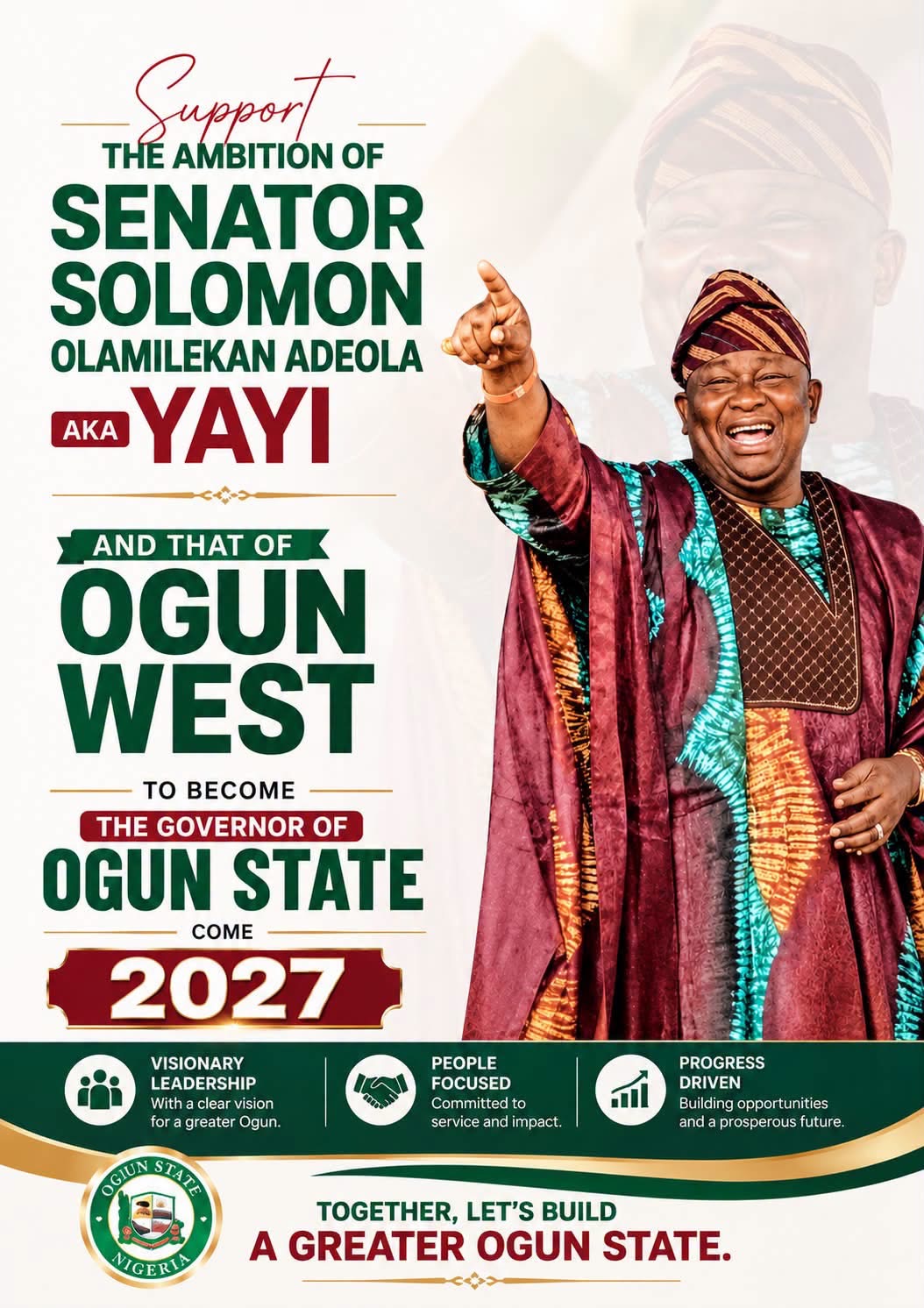
He said the development had a direct lesson for Ogun State, particularly regarding the growing political profile of Senator Solomon Olamilekan Adeola, popularly known as Yayi, who is seeking to become the next governor of the state.
According to Rahmon, Yayi’s increasing popularity cannot be explained solely by political structures, but also by what communities have experienced through his interventions over the years.
He noted that the senator had used his position to support grassroots development through interventions in roads, schools, scholarships, healthcare, empowerment programmes for farmers and traders, electricity projects and other community-focused initiatives.
Rahmon said such interventions could create lasting political goodwill because beneficiaries and residents tend to remember tangible projects and personal interventions long after political campaigns are over.
“People remember the road that was built. They remember the school that was renovated. They remember the empowerment that helped someone start a business. They remember the scholarship that supported their children,” he said.
The statement added that Yayi’s greatest political strength could be the personal connection he has developed with communities through his interventions and engagement with the people.
Rahmon also linked Yayi’s aspiration to the longstanding desire of Ogun West to produce a governor, describing his emergence as the APC consensus candidate as a significant step towards addressing the historical aspiration.
He, however, stressed that the Yayi project must go beyond the interest of an individual or a particular senatorial district.
According to him, the ambition must be presented as a broader Ogun project built around development, fairness, equity, inclusion and a sense of belonging for residents across the state.
Rahmon urged Yayi to remain focused on the people by sustaining development initiatives, listening to communities and maintaining regular engagement with residents.
He said the 2027 Ogun governorship election should not be reduced to political noise, accusations or campaign rhetoric, but should focus on the records, capacity, competence and credibility of the various contenders.
He identified key questions that voters should consider, including who has demonstrated the capacity to develop Ogun State, who understands the grassroots, who can unite the people and who has shown that leadership is about service rather than merely occupying an office.
Rahmon said Adeleke’s victory had reinforced the importance of genuine connection with the electorate.
“When people genuinely feel that a leader represents them, they will defend that leader. When they see development, they talk about it. When they experience good representation, they tell others. When they trust a leader, they become the campaign,” he said.
He maintained that Yayi’s strongest campaign would not necessarily be posters, political structures or social media activities, but the testimonies of residents who had benefited from his interventions.
“The mother who says her community now has better access; the student who benefits from an improved school and scholarship; the young and old whose lives have been changed through empowerment; the trader who received support; the community that got a road, light, water or other infrastructure. These stories are more powerful than any political speech,” he said.
Rahmon concluded that the Yayi project must remain a people-driven project and should be rooted in development, fairness, inclusion, trust and genuine service.
He added that when the people truly believe in a leader and identify with his vision, they are more likely to willingly support such a leader at the ballot box.

